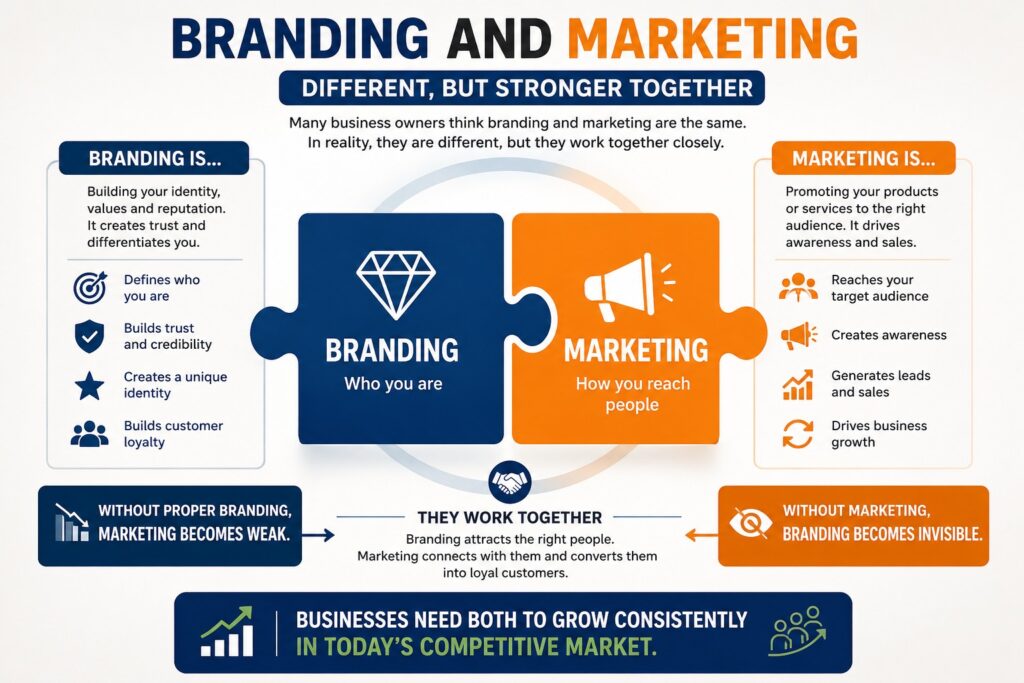
BRANDING AND MARKETING DIFFERENT BUT STRONGEST TOGETHER
Many business owners think branding and marketing are the same thing. In reality, they are different, but they work together closely. Without proper branding, marketing becomes weak. Without marketing, branding becomes invisible. Businesses need both to grow consistently in today’s competitive market.
In Kerala and across India, thousands of businesses are entering the digital space every year. Because of this, competition is becoming stronger than ever. Customers now have too many options. This means businesses cannot rely only on good products or services anymore. They also need strong brand positioning and effective marketing strategies.
Branding is how people remember your business. Marketing is how people discover your business.
That is the simplest way I explain it to clients.
Your logo alone is not your brand. Branding includes your visual identity, communication style, customer experience, messaging, values, design consistency, and overall perception in people’s minds. A strong brand creates emotional connection and trust.
Marketing is the process of promoting your business through channels like SEO, social media, paid ads, content marketing, email campaigns, influencer marketing, and more. Marketing helps bring attention. Branding helps build loyalty.
One common mistake I see is businesses spending money on advertisements without building proper brand identity first. This creates poor conversion rates because customers may notice the business but fail to trust it. People buy from brands they remember and trust.
For example, imagine two businesses offering the same service. One has professional branding, clear messaging, modern design, customer-focused content, and consistent visuals. The other has random designs, unclear communication, and no brand personality. Most customers naturally trust the first one more.
This is exactly why branding matters.
Good branding improves customer confidence. It creates familiarity. When people repeatedly see consistent messaging and design, they begin to recognize your business faster. Over time, this recognition increases conversion rates and customer retention.
SEO also benefits from strong branding. Google values user trust signals. Branded searches, content quality, user engagement, and website experience all contribute to better search visibility. This means branding indirectly supports digital marketing performance.
Modern consumers are emotional buyers. Even in B2B industries, decisions are influenced by perception and trust. Businesses that understand storytelling, positioning, and emotional branding often outperform competitors with bigger budgets.
Content marketing plays a major role here. Blogs, videos, social posts, and educational content help businesses communicate expertise while strengthening brand identity. This is why personal branding is also growing rapidly among freelancers, founders, and marketers in India.
Social media has made branding even more important because customers interact with businesses daily through digital platforms. Every post, caption, design, and interaction contributes to your brand perception. Consistency is critical.
Another important concept is brand differentiation. In crowded industries, businesses need a clear reason why customers should choose them instead of competitors. Branding helps communicate that unique value proposition clearly.
Marketing without branding often leads to short-term attention but weak long-term growth. Branding without marketing may create a great identity but limited visibility. The businesses growing fastest today combine both strategically.
I personally believe businesses should focus more on authenticity rather than copying competitors. Many brands fail because they imitate trends instead of building genuine identity. Customers can easily notice when branding feels artificial.
A good brand speaks directly to its audience. It understands customer pain points, desires, and expectations. This is why audience research is extremely important in digital marketing strategies.
Local businesses in Kerala also have huge opportunities today because regional branding is becoming powerful. Businesses that connect culturally and communicate locally often build stronger customer relationships.
Visual branding is important, but communication branding matters equally. The way you write captions, website content, emails, and advertisements affects how people perceive your business. Tone of voice plays a huge role in modern branding.
Another important factor is trust consistency. Customers expect the same quality across all touchpoints. Your website, Instagram page, advertisements, customer service, and offline experience should all feel connected.
Strong branding also improves marketing efficiency. Businesses with established trust often spend less money convincing customers because credibility already exists. This reduces customer acquisition friction.
As digital competition grows, branding will become one of the biggest business advantages. Products can be copied. Services can be replicated. But a strong brand identity is much harder to replace.
Businesses that invest in branding today are building long-term market value. They are creating recognition, trust, and emotional connection that continues growing over time.
If you want sustainable business growth in today’s digital world, branding and marketing should never be treated separately. They work together to create visibility, trust, authority, and customer loyalty.
The strongest businesses are not always the loudest. They are usually the ones people remember first.